LUCKY SOL Blog · Buying property
From a developer, or a resale property?
 Lucie and RadekLUCKY SOL, real estate agency on the Costa del Sol
An apartment from a developer, under construction or as a new build, or a resale property? How payments, taxes and guarantees work on the Costa del Sol, from our own experience.
In our last article we travelled along the coast together, town by town. Once you know where you want to live, you come to a question we hear from almost everyone. Should you buy an apartment or a villa from a developer, or a resale property from its current owner? Both routes lead to the same place, your second home by the sea. They differ, though, in how long you wait for the keys, how you pay, which taxes apply and what guarantees you have.
In the years we have lived here, we have helped with dozens of purchases. Lucie makes sure you understand every step of the purchase and that nothing takes you by surprise. Radek reads the plans and floor plans, goes to see how construction is progressing and finds on every property the things the photos don't show. In this article we explain what each route means in practice and who it suits.
Two ways to buy at a glance
- A developer project means buying directly from the developer, usually off-plan or during construction. You pay in stages. The reservation is usually €6,000 to €12,000, you pay up to 30% of the price when you sign the private purchase contract, and the rest at the notary. If the ground has not yet been broken on the plot, you wait roughly 24 months for the keys from the date the building permit is issued. For projects already under construction, it can be just a few months.
- With a finished project from a developer, you see exactly what you are buying, and you get the keys as soon as you sign at the notary.
- You buy a resale property from its current owner, whether it is older or almost new. It takes about two months from reservation to keys, and the area around it is already established.
- In Andalusia, you pay VAT 10% and stamp duty (AJD) 1.2% on a property from a developer, and transfer tax (ITP) 7% on a resale property.
- Under Spanish law, from the moment the building permit is issued, the developer must cover the deposits on a developer project with a bank guarantee or insurance. New homes carry a ten-year guarantee on the structure.
Two routes, one goal
We split property on the Costa del Sol into two groups depending on who you buy from, because each works differently. You buy a developer project directly from the developer, usually off-plan or while the building is still going up. That said, developers also sell apartments, townhouses and villas that are already built and ready to move into straight away. You buy a resale property from its current owner, who has lived in it or let it out. It may be an older property, but it may also be almost new, bought by the owner just a few years ago.
Most of our clients buy apartments in developer projects that are still under construction. But neither route is best for everyone. It depends on when you want the keys, how you want to pay and how you will use the property. Estate agencies here share their property listings with one another, so we can show you developer projects and resale properties from all along the coast, and you can compare them side by side.
Developer projects, a new home with no renovation
Under construction, when you have time
A project at the start of construction is ideal for those who are in no hurry and want to choose before everyone else. When a project goes on sale, almost all the apartments are still available. You can pick the floor, the view and which way the apartment faces. Apartments with the best views and the biggest terraces are always much sought after. You are buying a property in a modern building constructed to current standards. In Spain, any new building whose permit was applied for from the end of September 2020 onwards must meet the requirements for nearly zero energy consumption. But the biggest advantage, as we see it, is that you don't need to do any renovation after you buy. And the price at the start of sales is often very attractive. With us, you pay the same price as if you went straight to the developer's sales office. For some buyers it also helps that they don't have to pay everything at once.

First you pay the reservation, usually €6,000 to €12,000, sometimes more. The reservation money usually goes to the developer, who refunds it in full if the problem is on their side, for example if construction does not start or is postponed. If you are the one who changes your mind, the reservation is forfeited in full or in part, depending on the developer's terms. Then you sign the private purchase contract and pay up to 30% of the price. The reservation counts towards this amount. You pay the remaining 70% at the notary, once the building is finished and you take over the keys. VAT 10% is added to the price, and to every deposit too. At the notary you also pay stamp duty (AJD) 1.2%.
When you get the keys depends on how far the project has progressed. If the ground has not yet been broken on the plot, the home is handed over roughly 24 months after the building permit is issued. Projects already under construction tend to be finished sooner, sometimes in just three or four months. That is why, for every project, we tell you when you can expect the keys.
The question clients ask us most often is what happens to their money if the building is never finished. The Spanish Building Act covers exactly this. From the moment the building permit is issued, the developer must cover every deposit, including taxes and statutory interest, with a bank guarantee or insurance. The developer must receive the deposits into a special account kept separate from the company's other accounts and may use them only for the construction. If building does not start or is not completed by the agreed date, you can withdraw from the contract and get your deposits back with interest, or give the developer a new deadline. The developer must hand you the guarantee document when you sign the contract, and the lawyer checks it. You can choose an independent lawyer yourself, or we can recommend the one we work with, from whom we take no commission. It is not unusual on the coast for agencies to receive commission from the lawyers they recommend. We deliberately do not, so that the lawyer protects only your interests.
In all the years we have been doing this, our clients have never lost their money. Twice we have seen construction delayed, and both times the clients got their money back.
A finished project, keys straight after signing
A new build from a developer combines the advantages of a new home and a resale property. The building is new and modern, and yet it is already standing. You can walk round the very property you are buying. You will see the view from the terrace, hear how quiet it is around you and find out when the sun reaches it. The garden and communal areas are finished, and you can move in as soon as you have signed at the notary. Who does a finished project suit best? Those who don't want to deal with any renovation and want to live somewhere new. It is a bit like buying a car. Many people simply want a new one, not a used one.
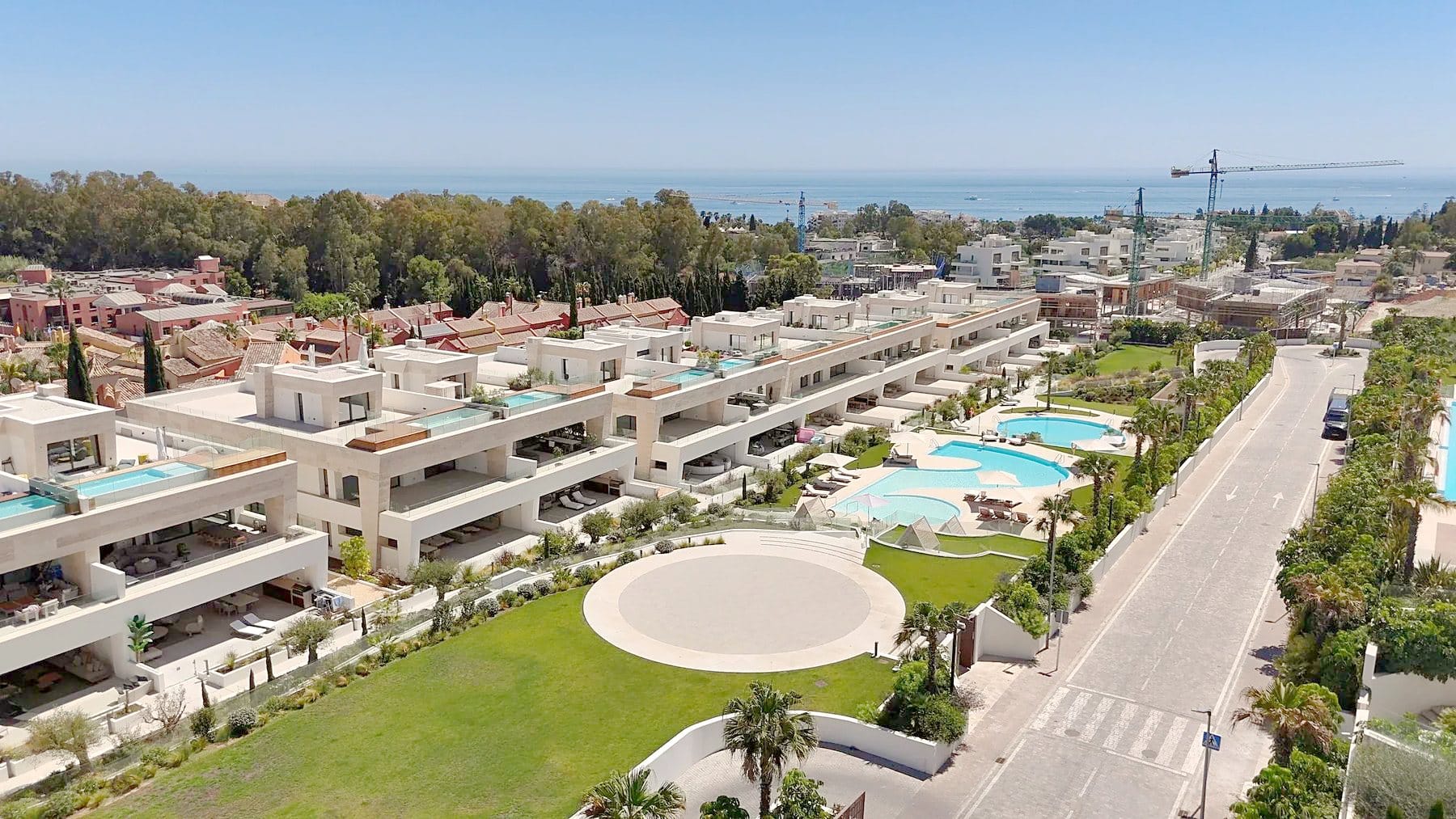
When it comes to taxes, it depends on who you are buying from. If you buy a finished apartment or villa directly from the developer, you normally pay the same taxes as for a project under construction. If the property has already had its first owner, you are buying it as a resale property and pay transfer tax (ITP) on it, even if it is almost new.
A new home is also protected by statutory guarantees. Those who built it are liable for ten years for structural defects, meaning defects in the foundations, columns, floor slabs or load-bearing walls. For three years they are liable for defects in installations and building elements that mean the home does not meet habitability requirements. These include things like water leaks or poor sound insulation. Finishing work carries a one-year guarantee. For new residential buildings, the ten-year structural guarantee must be insured, and it also passes to subsequent owners. All these periods, however, run from the handover of the building, not from your purchase. For a building that has been standing for a few years, it is therefore worth knowing how much of them is left.
We are happy to arrange a viewing together for a property in a developer project too. And if you want complete peace of mind, we can arrange a viewing with a technical specialist or an architect as well.
Resale property, a place already full of life
A resale property has one big advantage, and that is location. It often sits in an established neighbourhood, in a town centre or a short walk from the beach, where everything around it was finished long ago. You know who lives next door, what the garden looks like in full bloom and how much the community fees are. Lucie puts it to our clients quite simply.
“You can adapt and furnish the inside of an apartment to your own taste later, but you can't move the location.”
Lucie
It is also the quickest way to buy. You usually pay the reservation into the lawyer's account, and depending on the value of the property it ranges from €6,000 to around 1% of the price. Within a month you sign the deposit contract, known here as arras, and pay 10% of the price. The whole process from reservation to keys takes about two months. Instead of VAT and stamp duty, you pay only transfer tax (ITP) 7%.
When do we recommend a resale property? Mainly for frontline or second-line properties by the sea. New buildings are rare there, and when there is one, it tends to be considerably more expensive. That is where buying resale makes sense, even if you will then need to repair or renovate the property. The A-7 road runs along the coast, and inland of it we tend to recommend developer projects instead. Resale homes there are often twenty years old or more and almost always need renovating, which most clients do not want to take on. Those who want to let their property usually go for a new one. We often find that a client turns down an older apartment by the sea, saying they would rather be a little further back but have something new. With an older property we always look at the condition of the building, what will need repairing and whether a renovation would fit the budget. This is why we once talked a client out of a penthouse with a stunning view. After renovation it would have cost him far more than he wanted to spend, so we thought it better to tell him in good time.
An independent lawyer checks who the owner is, whether there are any debts or charges on the property and whether taxes and community fees have been paid. For a villa or an older property, it pays to bring in an architect or a technical specialist early, before you sign the deposit contract. On the morning of the notary signing, we walk through the whole property once more. We check that the agreed furniture and fittings are still there and that everything works.
How to choose
When someone tells us they don't know which route to take, we start with their lifestyle. We ask how they picture life here, whether they need to be right by the sea or could be a little further back, whether they will come in winter or in summer, alone or with family, and whether they plan to let the property. There are many more questions, and their answers guide our search. If you have time and want to choose the best apartment in a new building, a developer project under construction will suit you best. If you want a new home and the keys straight away, a finished project is the one to go for. And if you want a particular location, a quick purchase and an established neighbourhood, you will most likely find that in a resale property. Clients usually know whether they want a property from a developer or a resale one. Sometimes, though, we combine both on viewings, so they can compare the two options right there on the spot.

Whichever route you choose, you don't have to worry about furnishing. We are happy to hand over your apartment or villa fully furnished. We arrange everything you need through companies we work with. All you have to do is arrive and move straight in. And we are still here for you with advice and recommendations after the keys have been handed over.
What nobody tells you
With a developer project, study the floor plan carefully. It is not always clear from the plan whether something is a window or a door to the terrace. When it isn't clear, we ask the developer directly, so that you know exactly what you are buying.
Which way a property faces makes a real difference to how it feels to live there. South and south-west get sun almost all day, south-east and east will delight anyone who loves the morning sun, and the north side tends to be cooler in winter. With a project that is still being built you cannot see this for yourself, so we always point out the orientation in advance.
The energy label, on a scale from A to G, must appear in every listing and advertisement, so you will find it in the property ad. For a building under construction you receive a label based on the project, and on completion a certificate for the finished building. When you buy a finished home, the energy certificate is attached to the purchase contract and is valid for no more than ten years. With a resale property, it is a good idea to write down what stays in it after the purchase, from furniture to appliances. We keep an eye on this for you, so that there is no misunderstanding later.
The two routes in figures
| Aspect | Developer project | Resale property | Source |
|---|---|---|---|
| What you buy | a property directly from the developer, off-plan, under construction or completed | a property from its current owner, older or almost new | our experience |
| Reservation | usually €6,000 to €12,000, sometimes more, mostly paid to the developer | from €6,000 to around 1% of the price, usually into the lawyer's account | our experience |
| Further payments | during construction, up to 30% of the price on signing the private purchase contract, 70% at the notary | 10% within a month (arras), the rest at the notary | our experience |
| When you get the keys | depending on the construction stage, from a few months up to around 24 months after the building permit is issued, for a finished project on signing at the notary | around 2 months from reservation | our experience |
| Taxes (Andalusia) | VAT 10% + stamp duty (AJD) 1.2% | transfer tax (ITP) 7%, even for an almost new property | Junta de Andalucía; VAT Act |
| Protection of deposits | bank guarantee or insurance, special account, refund with interest | no deposits are paid during construction | Law 38/1999, additional provision 1 |
| Statutory guarantees from handover of the building | 10 years on the structure, 3 years on defects affecting habitability, 1 year on finishing work | whatever remains of these periods, if they are still running | Law 38/1999, art. 17 |
| Energy label | label based on the project, building certificate on completion | certificate attached to the purchase contract (valid for up to 10 years) | Real Decreto 390/2021 |
| Viewing with us | viewing, if you wish with a technical specialist or an architect | for a villa or an older property, an architect or a technical specialist before the deposit contract, check of furniture and fittings on the morning of the notary signing | our experience |
| Help after the purchase | advice and recommendations even after the keys are handed over | advice and recommendations even after the keys are handed over | our experience |
Information correct as of 20 October 2026.
Frequently asked questions
What is the difference between a developer project and a resale property?
You buy a developer project directly from the developer. If the ground has not yet been broken on the plot, you wait roughly 24 months for the keys from the date the building permit is issued. If construction is already under way, it can be just a few months, depending on the stage. You can move into an apartment or villa in a finished project as soon as you sign at the notary. You buy a resale property from its current owner, and instead of VAT and stamp duty you pay transfer tax (ITP) 7% on it, even if it is almost new.
Is buying off-plan in Spain safe?
Yes, deposits are protected by Spanish law. From the moment the building permit is issued, the developer must cover every deposit with a bank guarantee or insurance and receive it into a special account. If building does not start or is not finished on time, you can withdraw and get your deposits back with interest. The guarantee is always checked by an independent lawyer. In all the years we have been doing this, our clients have never lost their money.
What taxes do I pay when buying from a developer or a resale property?
In Andalusia, you pay VAT 10% and stamp duty (AJD) 1.2% on a property from a developer. On a resale property you pay transfer tax (ITP) 7%, even if it is almost new. On top of that, allow for the costs of the lawyer, the notary and registration at the Land Registry (Registro de la Propiedad).
What guarantees come with a new build in Spain?
Under the Building Act, there is a ten-year guarantee on structural defects, three years on defects that stop the home from being properly habitable, and one year on finishing work. The periods run from the handover of the building. The ten-year guarantee must be insured and also applies to subsequent owners.
How long does it take to buy a resale property?
About two months from the reservation. Within a month of the reservation you sign the deposit contract (arras) and pay 10% of the price, and the rest is paid at the notary.
Do I get the reservation back if I change my mind?
With a developer project, the reservation is refunded in full if the problem lies with the developer, for example if construction does not start or is postponed. If you are the one who changes your mind, the reservation is forfeited in full or in part, depending on the developer's terms. With a resale property, the reservation is refunded if the legal checks uncover a problem.
What is an energy label?
On a scale from A to G, it shows how energy efficient the building is. It must appear in every listing and advertisement, and the energy certificate is attached to the purchase contract. For a building under construction you receive a label based on the project.
Which is better, a new property or a resale property?
It depends on when you want the keys, how you want to pay and how you will use the property. A developer project under construction offers the widest choice and you pay in stages, a finished project gives you a new home with the keys straight away, and a resale property offers an established neighbourhood and a quick purchase. The best way is to compare both routes on the spot.
Would you like to know more?
Torn between a developer project and a resale property? Write to us and we will arrange a short call. Based on what you are looking for, we will put together a selection of developer and resale properties and will be happy to show them to you in person.
Lucie and Radek Špreňar
We run LUCKY SOL, a family real estate agency. We have lived on the Costa del Sol all year round since the end of 2018 and help Czechs and Slovaks buy their second home by the sea. We are always on the buyers' side.
Updated 20 October 2026
This article is general information based on our experience and is not legal or tax advice. Correct as of October 2026.
Sources
- BOE, Ley 38/1999 de Ordenación de la Edificación (Building Act), consolidated text: art. 17 (liability of 10 years for the structure, 3 years for habitability, 1 year for finishing work, periods running from handover of the building), art. 3.1.c (habitability requirements), art. 19 and additional provision 2 (compulsory ten-year insurance for residential buildings, insurance also covering subsequent owners), art. 20. https://www.boe.es/buscar/act.php?id=BOE-A-1999-21567
- BOE, Ley 38/1999, additional provision 1 (disposición adicional primera), percepción de cantidades a cuenta del precio durante la construcción: bank guarantee or insurance for deposits from the issue of the building permit, special account, refund of deposits including taxes and statutory interest, withdrawal or a new deadline. As amended by Ley 20/2015 (disposición final tercera), in force from 1 January 2016. https://www.boe.es/buscar/act.php?id=BOE-A-1999-21567#daprimera
- BOE, Ley 20/2015 de ordenación, supervisión y solvencia de las entidades aseguradoras y reaseguradoras (disposición final tercera amends Law 38/1999). https://www.boe.es/buscar/act.php?id=BOE-A-2015-7897
- BOE, Real Decreto 732/2019 (CTE building standards, requirements for nearly zero-energy buildings). https://www.boe.es/buscar/act.php?id=BOE-A-2019-18528
- BOE, Real Decreto 390/2021 on the energy certification of buildings: art. 13 (certificate valid for up to 10 years, 5 years for class G), art. 15 (label in every listing and advertisement), art. 17 (label based on the project for buildings under construction, certificate attached to the purchase contract), preamble (EU Directive 2010/31/EU, deadline 31 December 2020). Nearly zero-energy requirement for new buildings with a permit application from 24 September 2020 under RD 732/2019: https://www.codigotecnico.org/noticias/2020-07-08-Nota-informativa-reanudacion-plazos.html. https://www.boe.es/buscar/act.php?id=BOE-A-2021-9176
- BOE, Ley 37/1992 on VAT: art. 20.Uno.22 (the second and any subsequent transfer of a building is exempt from VAT, transfer tax is paid instead), art. 75.Dos (VAT on deposits), art. 91 (reduced rate of 10% for residential property). https://www.boe.es/buscar/act.php?id=BOE-A-1992-28740
- Junta de Andalucía: rates of transfer tax (ITP) 7% and stamp duty (AJD) 1.2% in Andalusia, Ley 5/2021. https://www.juntadeandalucia.es/organismos/economiahaciendayfondoseuropeos/areas/tributos-juego/tributos/paginas/tipositpajd.html
Authors: Lucie and Radek